
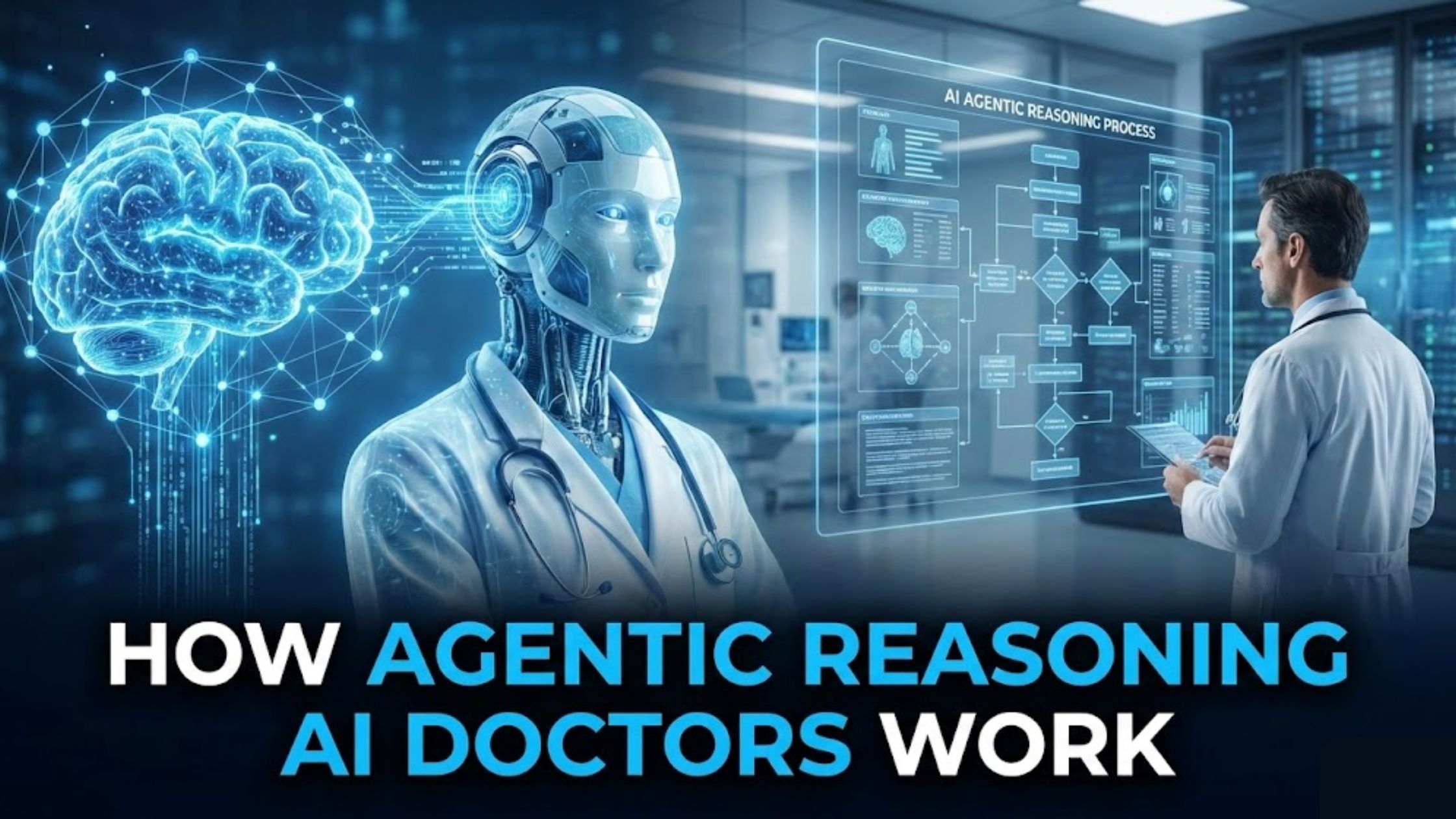
In recent years, Artificial Intelligence has transitioned from a futuristic concept to a daily reality in healthcare. However we are currently witnessing a monumental shift from Generative AI (like basic chatbots) to Agentic Reasoning AI. This evolution marks the birth of the Agentic Reasoning AI Doctor a system that does not just predict the next word in a sentence but thinks, plans, and acts like a medical professional.
In this comprehensive guide we will explore the inner workings of Agentic Reasoning why it is superior to traditional AI and how it is set to redefine the patient doctor relationship.
Defining the “Agentic” Shift in Healthcare
To understand how an Agentic Reasoning AI Doctor works, we must first define agency. In the field of AI, an agent is a system that can perceive its environment reason about its goals and take independent actions to attain them.
While ordinary medical AI could review an X-ray and state, There is a 90% likelihood of pneumonia, an Agentic AI Doctor goes deeper.It believes, Since there is a significant risk of pneumonia, I need to examine the patients oxygen saturation look at their antibiotic allergy history and offer a specific treatment plan. It does not only give data; it provides a solution.
The Core Mechanism: How Does Agentic Reasoning Work?
The Reasoning part of these AI doctors is powered by sophisticated architectural frameworks. Unlike a simple search engine an Agentic AI follows a loop based logic system:
A. Dynamic Planning
When presented with a complex medical case the AI creates a multi step roadmap. It breaks down a nonspecific symptom (like fatigue) into a number of investigative processes such as evaluating bloodwork, checking lifestyle factors, and cross-referencing uncommon genetic markers.
B. Tool Augmentation (Using Medical APIs)
An Agentic AI Doctor is not limited to its internal training data. It has the authority to use external tools. These include:
- Medical Calculators: For precise dosing.
- Search Engines: To find the latest peer reviewed journals published only hours ago.
- EHR Integration: To retrieve and analyze Electronic Health Records in real time.
C. Self Correction and Reflection
One of the most critical aspects of Agentic Reasoning is the Self Correction loop. If the AI suggests a diagnosis that doesn’t align with a new lab result, it doesn’t ignore the discrepancy. It re-reasons admits the previous hypothesis was wrong and pivots to a more accurate conclusion.
Comparing Traditional AI vs. Agentic Reasoning AI
| Feature | Traditional Medical AI | Agentic Reasoning AI Doctor |
| Primary Function | Pattern Recognition | Goal-Oriented Problem Solving |
| Logic | Single-step (Input → Output) | Multi-step (Input → Plan → Act → Reflect) |
| Autonomy | Low (Needs constant prompts) | High (Operates independently) |
| Context | Limited to current input | Deep integration with patient history & tools |
The Impact on Clinical Decision Making
The implementation of Agentic Reasoning AI Doctors brings three major advantages to the medical field:
- Reducing Cognitive Load for Human Doctors: Doctors are currently overwhelmed by paperwork. Agentic AI can handle the detective work of gathering data allowing human physicians to focus on the physical examination and emotional support.
- Eliminating Diagnostic Bias: Humans are prone to anchoring bias sticking to the first diagnosis that comes to mind. An Agentic AI considers all possibilities equally until the evidence points to a single conclusion.
- Real Time Monitoring: In ICU scenarios an Agentic AI can monitor vitals and automatically modify oxygen levels or alert staff before a patients condition gets serious.
Ethical Considerations and Safety
As with any autonomous technology the introduction of AI doctors brings serious ethical questions.
- The Black Box Problem: How do we know why the AI made a specific decision? To combat this developers are integrating Explainable AI (XAI) into Agentic models so they can show their work.
- Liability: If an AI agent makes a mistake who is responsible? Currently the consensus is the Human in the Loop model where the AI suggests but the human doctor approves.
- Data Security: Protecting patient privacy is crucial when an AI agent has the power to traverse several medical databases.
The Future: 2026 and Beyond
By 2026 we expect Agentic AI to transcend beyond experimental programs into mainstream clinics. We are moving toward a world of Digital Twin medicine where an Agentic AI Doctor maintains a digital model of your body, running simulations on how you would react to different medications before you even take them.
Conclusion
The Agentic Reasoning AI Doctor is not only a trend; it is the next logical stage in medical progress. By mixing the massive knowledge of a machine with the logical reasoning of a scientist these technologies are intended to make healthcare more precise, personalized and accessible for everyone.
FAQs (Frequently Asked Questions)
Is an Agentic AI Doctor safe for diagnosis?
Yes, when utilized as a decision support tool. These systems are trained on millions of medical records and are supposed to follow stringent clinical norms. However, they are currently employed to assist not replace human doctors.
How is Agentic Reasoning different from ChatGPT?
While ChatGPT can answer medical questions, it cannot “act.” An Agentic AI can “reason” through a process, use external medical tools, and change its mind based on new data, making it far more reliable for clinical use.
Can these AI physicians manage emergencies?
In emergency rooms Agentic AI can help triage patients by assessing the severity of symptoms faster than a person ensuring that the most essential patients get seen first.
Will AI physicians make healthcare more expensive?
On the contrary by catching diseases early and decreasing the need for repetitive testing Agentic AI is predicted to drastically cut the overall cost of healthcare in the long run.