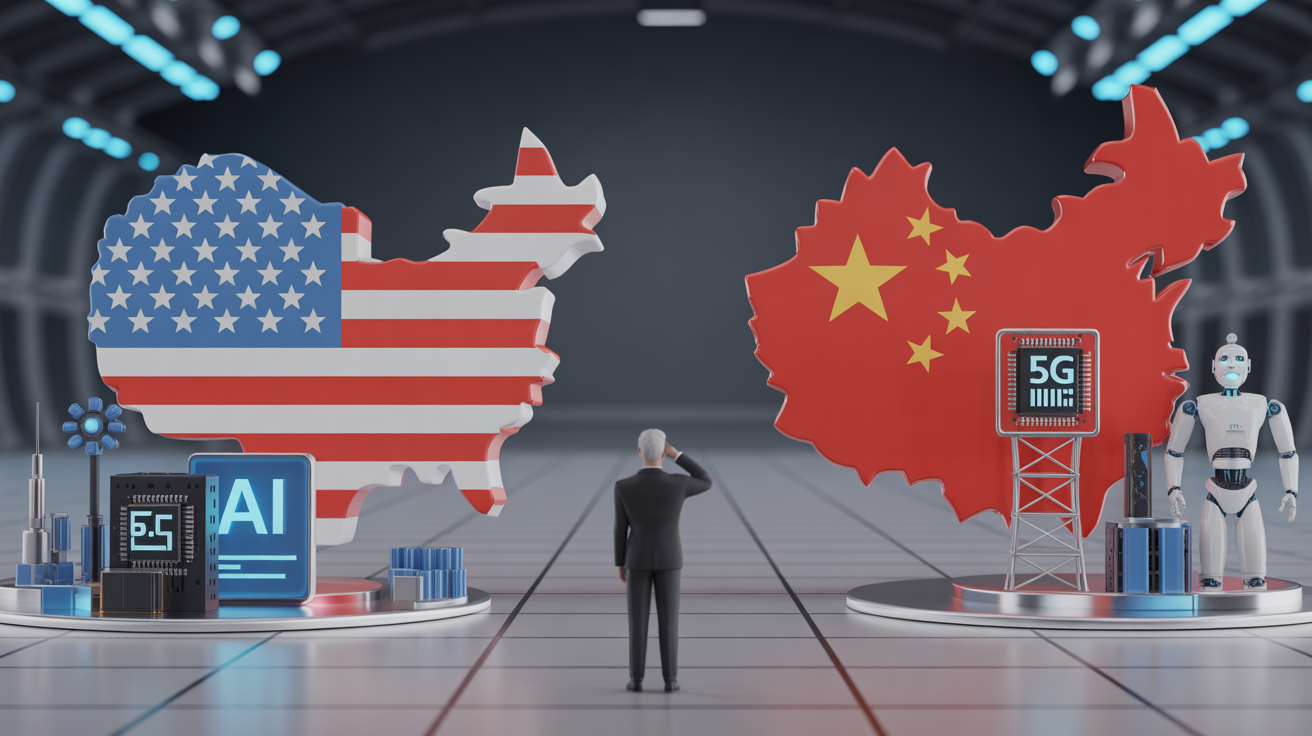
The US China technology competition Dimon has highlighted is rapidly reshaping the global balance of power.This competition affects more than just new ideas; it also affects the economy, global leadership, and the future of world leadership. Jamie Dimon, the CEO of JPMorgan Chase, has made it quite apparent that in the 21st century, a country’s strength will be based more on its financial and technological might than on its military power. The US and China are in a race to control important technologies like quantum computing, semiconductor manufacturing, artificial intelligence, and sophisticated telecommunications. These technologies will lead to the next phase of global innovation.
Dimon’s ideas are especially interesting because they connect capital markets, strategic investment, and technical leadership. They indicate that financial institutions do more than just encourage innovation; they also help decide which country will dominate the world economy. For businesses, investors, and governments, comprehending this rivalry is no longer a choice; it is necessary to deal with the risks and opportunities of a world that is becoming more and more defined by technical domination.
Who Is Jamie Dimon and Why His Perspective Is Important
You need to know who sent the message to realise how important it is. Jamie Dimon is not a politician, but many often say that he is one of the most important voices in American public policy. He runs the biggest bank in the US by market capitalization, which moves trillions of dollars every day.
Jamie Dimon’s role as CEO of JPMorgan Chase
Dimon has led JPMorgan Chase during the 2008 financial crisis, the COVID-19 epidemic, and many other political and economic upheavals. People in the financial sector read his yearly letters to shareholders as if they were the Bible. They often spend a lot of time talking about current events. Dimon has a big-picture vision of how technology, policy, and capital work together, unlike tech CEOs who may only care about their own area.
His influence on global finance and technology investment
Banks are what make new ideas happen. JPMorgan Chase spends billions of dollars a year on AI, cybersecurity, and blockchain. They are a huge investor in technology itself. Dimon can see for himself which technology can grow and where the money is going. When he talks about a disparity in US competitiveness, he’s not just talking about politics; he’s looking at the actual numbers of investment flows.
Why Dimon’s views carry weight in US–China relations
US China technology dimon is in touch with leaders in both Washington and Beijing. He runs a bank with a lot of business in China and fights for American interests. This dual role gives him a practical point of view: he sees China as a strong competitor but says that complete isolation would be bad for the economy.
Understanding the US China Technology Competition Dimon
When US China Technology Competition Dimon talks about this competition, he’s not simply talking about who makes the finest smartphone. He is talking about a basic fight for economic and military dominance in the 21st century.
What the technology competition means in economic and security terms
In the past, economic integration was seen as a way to prevent conflict. Today, economic connectivity is viewed as a vulnerability. The competition is driven by the realization that economic security is national security. A dependency on a rival for critical technology—like semiconductors or medical supplies—is now considered a strategic risk.
How innovation has replaced trade as the main battleground
The trade war was fought via tariffs. Controls on exports and limits on investments are the weapons of the tech war. The goal has changed from defending existing industries, like steel, to taking over new ones, like generative AI. Dimon has said that the country that is best at these technologies will define the rules for how they are utilised, controlled, and made money from.
Competition versus cooperation in a fragmented global system
The US used to be the only superpower in the globe, but now there are many smaller powers. Dimon often says that competition is good and necessary, but that not having clear rules can cause problems. The hard part is figuring out how to work together on global problems like climate change and nuclear stability while yet competing hard in technology.
Key Technologies Driving the US China Technology Competition Dimon
Several specific sectors are defining this rivalry. These are the areas where Dimon and other analysts see the highest stakes.
Artificial intelligence and advanced automation
AI is the force multiplier. It enhances productivity in the private sector and military capabilities in the defense sector.
- AI leadership: The US is now ahead in generative AI, because to businesses like OpenAI and Google. However, China is putting a lot of money into catching up.
- Regulation and security: Dimon has said that wicked people will use AI. It’s not only about making the smartest AI; it’s also about keeping an eye on the safety standards and rules that go along with it.
Semiconductor manufacturing and chip dominance
If data is the new oil, chips are the internal combustion engine.
- Supply chains: The world relies heavily on advanced chips manufactured in Taiwan. This geographic concentration is a major flashpoint.
- Export controls: The US has restricted the sale of high-end chips to China to slow its military modernization. This has forced China to accelerate its domestic chip-building efforts, a move Dimon watches closely as it alters global supply chains.
Quantum computing and next-generation research
Quantum computing promises to solve problems that are currently impossible for classic computers, from drug discovery to breaking encryption codes.
- Strategic advantages: The nation that masters quantum computing first will have a massive advantage in cybersecurity and intelligence.
- Future breakthroughs: This is a long-term play, but investment here acts as a hedge against future technological surprises.
Telecommunications and digital infrastructure
The rollout of 5G demonstrated how infrastructure can become political.
- Global standards: The US campaign to remove Huawei gear from allied networks was a clear signal that digital plumbing is political.
- Data sovereignty: Control over the flow of data across borders is essential. Dimon emphasizes that financial data and personal data must be secure from state-sponsored espionage.
Jamie Dimon’s Statements on the US–China Technology Competition
Dimon rhetoric on this topic is often a mix of confidence and caution.
What Jamie Dimon has publicly said about China’s technology rise
Dimon has said that China has done a good job of following through on its full economic strategy over the past 30 years. He doesn’t say they can’t do it. But he typically tells investors that China has a lot of problems on the inside, such a growing population and high youth unemployment, that could get in the way of their innovation goals.
His warnings about US innovation and competitiveness
His sharpest warnings might be aimed at the US administration. Dimon has said that Washington is stuck and that there is no clear industrial strategy. He says that the US can’t win a technology race if it can’t construct infrastructure, make its schools better, or change its immigration laws to keep skilled workers.
Why Dimon emphasizes strength over isolation
Dimon has said that we shouldn’t be terrified of China. He believes that the US will inevitably win the race if it boosts its own economy through better policies and investment. He thinks that being alone is a sign of weakness, not power.
Financial Power and Technology Leadership
You cannot build a tech superpower without deep capital markets. This is where the US has a distinct home-field advantage.
How capital markets shape technological dominance
People all across the world want to have a venture capital structure like the one in the US. It lets those with hazardous ideas acquire money. Dimon said that US tech businesses may grow faster than their competitors because the financing markets are deep, liquid, and clear. China’s system is state-directed, which lets it move huge amounts of money swiftly, but it often misallocates capital because of political aims instead of market goals.
The role of banking and investment in innovation ecosystems
Banks like JPMorgan Chase provide the credit and advisory services that tech giants need to acquire startups and expand globally. A healthy banking sector supports a healthy tech sector.
US Strategy in the Technology Competition
The US approach has evolved from passive observation to active containment and investment.
Government policies influencing technology leadership
The CHIPS and Science Act is the prime example of modern US industrial policy. It provides billions in subsidies to bring chip manufacturing back to American soil. This aligns with Dimon’s call for the government to play a role in securing critical industries.
Strengths and weaknesses of the US innovation ecosystem
- Strength: University research systems, rule of law, and a culture of entrepreneurship.
- Weakness: Crumbling physical infrastructure, political polarization, and a shortage of STEM graduates compared to China.
China’s Technology Strategy and Global Ambitions
China is not sitting idle. Their strategy is focused on breaking reliance on the West.
Long-term planning and state-backed innovation
Beijing tells state-owned companies and private champions to take over certain industries through programmes like “Made in China 2025.” They play the long game and often give up short-term profits to get more market share.
Technology self-reliance
China is spending a lot of money on its own semiconductor business since it can’t acquire US chips. Dimon says that export limitations cost China in the near term, but they encourage China to establish a tech environment that is wholly apart from the rest of the world in the long term.
Decoupling, De-Risking, and Global Technology Realignment
This is the most debated aspect of the rivalry.
Partial decoupling versus selective cooperation
Total decoupling—cutting all economic ties—is widely viewed by experts, including Dimon, as disastrous. It would cause a global depression. Instead, the focus is on “de-risking.” This means staying connected for general trade (soybeans, sneakers) but cutting ties in sensitive areas (AI chips, quantum tech).
Jamie Dimon’s preferred approach to managing competition
Dimon advocates for a “tough engagement” strategy. The US should protect its vital interests aggressively but maintain open lines of communication to prevent accidental war. He believes global trade is still a net positive.
Risks Highlighted by Jamie Dimon
The competition is not without danger.
Economic instability from prolonged technology conflict
If the world splits into two distinct technology blocs—one using US tech, one using Chinese tech—it creates inefficiency. Costs go up for businesses that have to duplicate their supply chains.
The strategic risk of underestimating competitors
Hubris is a danger. Dimon often warns that assuming the US will always be number one is a mistake. The US must earn its leadership position every decade.
Opportunities Created by the US–China Technology Competition
Pressure creates diamonds. Competition forces evolution.
Faster innovation driven by global rivalry
The AI race is speeding up discoveries that could have taken decades otherwise, just like the Cold War space race gave us satellite technology. The “US–China Technology Competition Dimon” is urgent, which helps get money and attention.
New investment and growth opportunities
Investors are looking for the next “neutral” manufacturing hubs. Countries like India, Vietnam, and Mexico are benefiting as companies diversify away from China. This creates new emerging markets for investors.
What the US China Technology Competition Means for the Future
Looking ahead, the landscape will likely remain tense but integrated.
Scenarios for technology leadership beyond 2026
We may see a bifurcation of the internet ,where digital standards differ between East and West. However, American soft power and software dominance remain difficult to dislodge.
Jamie Dimon’s outlook on global economic stability
Dimon remains a long-term optimist on America. He believes that the US economy is resilient and that its system of democracy and free enterprise creates the best environment for innovation—provided the country can get its political house in order.
Conclusion
The US China technology competition Dimon analysis ultimately serves as a wake-up call. Jamie Dimon’s perspective combines the cold hard numbers of a banker with the strategic foresight of a diplomat. He reminds us that technology is no longer just a business sector; it is the currency of geopolitical power.The fate of technological leadership—and, by extension, global influence—will be decided by the choices America makes now. Winning this competition demands bold investment at home, unwavering protection of critical assets, and the strategic wisdom to out-innovate rather than out-isolate. As Jamie Dimon warns, complacency is not an option. The future is still America’s to shape—but only if it acts with purpose, unity, and relentless drive.
Frequently Asked Questions
What is the US–China technology competition according to Jamie Dimon?
Jamie Dimon views it as a strategic rivalry for economic and security dominance, focused on critical technologies like AI and chips, where the US must maintain its lead through investment and smart policy rather than just tariffs.
Why does Jamie Dimon warn about US complacency?
He believes that relying on past success is dangerous. He argues the US needs to fix internal issues—like education, infrastructure, and fiscal policy—to compete effectively against a focused rival like China.
Does Dimon support decoupling from China?
No. He supports “de-risking” but believes full decoupling would be economically devastating for the US and the global economy. He advocates for trade in non-sensitive areas.
Which technologies are most critical in the rivalry?
Artificial Intelligence (AI), semiconductors (chips), quantum computing, biotechnology, and green energy technology are seen as the most important.
How does this competition affect global finance?
It forces capital to choose sides in sensitive sectors, alters investment flows toward “safe” supply chains, and increases the risk premium on geopolitical instability.
Why is Jamie Dimon warning about the US–China tech race?
Dimon said that the US could lag behind China if it doesn’t take technological innovation seriously. He says that being in charge of AI, semiconductors, and telecom will be important for both national security and economic power. His warning links the need for finance, investment, and strategic policy to keep the US in the lead in the world.
Does Dimon support decoupling from China?
Dimon doesn’t say that full decoupling is necessary, but he does point out the dangers of relying too much on China for important technologies. He supports strategic diversification, making the supply chain more resilient, and investing in new ideas in the US. This method strikes a balance between competition, economic stability, and technical growth.
Which technologies are most critical in the US–China rivalry?
According to Dimon, artificial intelligence, quantum computing, semiconductor manufacturing, and advanced telecommunications are the most decisive. Leadership in these areas will shape future innovation, economic power, and national security. Both countries are investing heavily to control these transformative technologies.
How does this competition affect global finance and businesses?
Dimon says that there is a direct correlation between technology leadership and financial systems. Investment flows, financial markets, and funding methods will decide which firms and countries are at the forefront of innovation. Companies need to be able to deal with the risks in their supply chains, changes in regulations, and new market dynamics that come from this competition.
Why Aitechk is Becoming a Leader in Technology
Aitechk is becoming a leader in technology by driving innovation in AI, advanced data solutions, and smart infrastructure. Its cutting-edge developments position it at the forefront of the US–China technology competition, aligning with Jamie Dimon’s warnings about the importance of technological and financial strength. By combining strategic investment, global partnerships, and next-generation solutions, Aitechk is shaping the future of innovation and industry leadership.